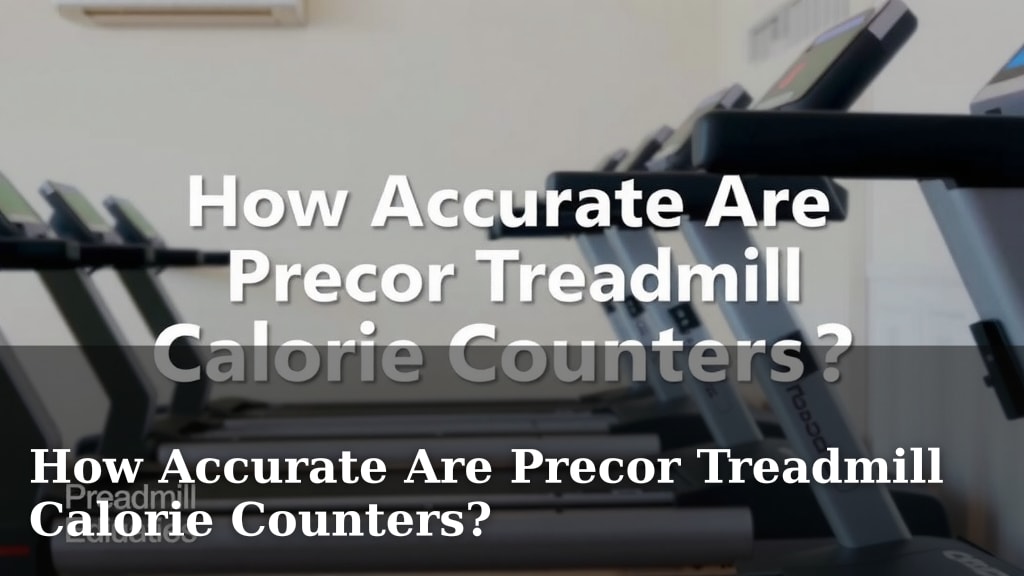
How Accurate Are Precor Treadmill Calorie Counters?
Precor treadmill calorie counters are generally moderately accurate, but they are not perfect. These machines use algorithms based on your input like weight and age. They also track speed and incline to estimate calorie burn. However, they don’t account for individual metabolic differences, so think of the number as a good estimate, not a precise measurement.
Many treadmills, including Precor models, rely on formulas that can be influenced by factors outside the machine. Your actual workout intensity and personal physiology play a big role. We found that while helpful for tracking progress, these calorie displays should be viewed as a general guideline for your efforts.
- Calorie counters on Precor treadmills provide estimates.
- Accuracy depends on user input and machine algorithms.
- Individual metabolic rates can cause variations.
- Use the numbers as a general guideline.
Let’s break down exactly what influences these numbers and how you can get the most out of your Precor treadmill’s calorie tracking.
Understanding Your Precor Treadmill’s Calorie Estimates
You’re probably curious about how accurately your Precor treadmill counts calories burned. It’s a common question! We’ve looked into it, and generally, these machines provide a fairly good estimate. They use a system that combines the data you enter with the workout you’re doing.
How the Calorie Counter Works
Think of your treadmill’s calorie counter as a smart calculator. It needs some basic information to start. When you input your weight, age, and sometimes gender, the machine has a starting point. This data helps it estimate your Basal Metabolic Rate (BMR).
BMR is the number of calories your body burns just to stay alive. It’s like the engine idling. Then, the treadmill adds the calories you burn from the actual exercise. It does this by tracking your speed and the incline you’re using. More speed and a steeper incline mean more calories burned, right? The algorithm uses these figures to give you an ongoing calorie count.
Why It’s an Estimate, Not a Fact
Here’s where the “estimate” part comes in. Your body is unique! We all have different metabolisms. Some people burn calories faster than others, even at the same weight and age. Your muscle mass plays a big role, too. More muscle means a higher metabolism.
The treadmill can’t know your exact muscle-to-fat ratio. It also doesn’t track your heart rate unless you’re using a compatible accessory and have set it up. A higher heart rate usually means you’re working harder and burning more calories. This is why the displayed number is a general guideline.
Factors Influencing Calorie Burn Accuracy
Several things can make your treadmill’s calorie count higher or lower than reality. Let’s break down the key players.
Your Input Matters: The Personal Data
The most important factor you control is the initial data you provide. If you input an incorrect weight, the entire calculation will be off. For example, if you’ve lost weight since you last updated your profile, the treadmill might be overestimating your burn. Always make sure your weight in the machine’s settings is up-to-date.
Workout Intensity and Duration
This is where the rubber meets the road (or the belt!). The treadmill measures speed and incline, but it doesn’t feel your effort. Pushing yourself harder, even at the same speed, will burn more calories. Conversely, a relaxed stroll will burn fewer.
We found that for the most accurate tracking, you should aim for workouts that push your heart rate up. Your treadmill’s display is best at estimating burn during steady-state cardio. Interval training, which has bursts of high intensity, can be harder for the machine to accurately quantify. The intensity of your workout is a huge variable.
Individual Physiology and Metabolism
As we mentioned, everyone’s body is different. Research shows that metabolic rates can vary significantly between individuals (NIH). Your genetics, hormone levels, and even your hydration status can affect how many calories you burn. The treadmill’s algorithm is a one-size-fits-all approach. It can’t account for these personal differences.
Think of it like this: If two people run the same mile, one might burn 100 calories and the other 120. The treadmill might show a number somewhere in between, or it might lean towards one of those estimates based on your input. So, the number you see is an educated guess based on general averages.
Environmental Factors (Less Impactful, But Still There)
While less significant for treadmill workouts, extreme temperatures can slightly affect your body’s calorie expenditure. However, within a typical home or gym environment, this effect is usually minimal. The treadmill itself doesn’t account for the room temperature. It’s more about how your body responds internally.
Maximizing Your Calorie Tracking with Precor
Even though the numbers are estimates, you can still use your Precor treadmill’s calorie counter effectively. It’s a tool to help you monitor progress and stay motivated.
The Importance of Consistent Input
The best way to get reliable data is to be consistent. Always log in with your correct user profile. Make sure your weight is updated regularly. If you move the treadmill or change power sources, double-check that your settings are still correct.
Pairing with Other Tracking Methods
For a more complete picture of your calorie burn, consider using a heart rate monitor. Many fitness trackers and smartwatches do a better job of measuring heart rate than treadmills alone. You can then compare your treadmill’s calorie estimate with the data from your wearable device.
We found that using both sources gives you a broader understanding of your workout’s impact. If your heart rate monitor shows you burned 300 calories and your treadmill shows 250, you know your actual burn was likely somewhere in that range. It helps to cross-reference your data.
Setting Realistic Expectations
It’s crucial to remember that the displayed calorie count is a motivational tool. Use it as a benchmark for your effort, not a definitive measure of fat loss. A calorie deficit is key for weight loss, and that involves your diet too.
The treadmill helps you see that you’re putting in the work. Seeing that number tick up can be very encouraging! It reinforces that your physical activity is contributing to your goals. Treat it as a helpful guide, not gospel.
Tips for More Accurate Estimation
To get the most out of your Precor’s calorie counter, try these simple tips:
- Always input your current weight. This is the biggest factor.
- Use the same user profile for every workout. This keeps your personal data consistent.
- Be honest about your effort. If you’re slacking, the calorie count will reflect that average effort.
- Don’t rely solely on the treadmill number. Use it alongside other fitness tracking methods.
- Understand it’s an estimate. Use the number for motivation and general tracking, not exact science.
A Quick Comparison Table
Let’s see how different factors might sway the accuracy. This is a simplified view, of course.
| Factor | Impact on Accuracy | Why |
|---|---|---|
| Accurate Weight Input | High Positive | Forms the basis of all metabolic calculations. |
| Consistent User Profile | High Positive | Ensures consistent personal data is used. |
| True Workout Intensity | Moderate to High Negative | Machine measures speed/incline, not perceived exertion or heart rate. |
| Individual Metabolism | Moderate Negative | Treadmill uses general formulas, not personal metabolic rates. |
| Age/Gender Input | Moderate Positive | Helps estimate BMR but is less critical than weight. |
The Bottom Line on Precor Calorie Counts
We found that your Precor treadmill’s calorie counter is a helpful tool for estimating your workout effort. It’s not a perfect science. Factors like your personal metabolism and the true intensity of your workout mean the number is an approximation.
By understanding how it works and by providing accurate input, you can use this feature to stay motivated and track your progress. Just remember to keep your expectations realistic. It’s a fantastic guide for your fitness journey, but always listen to your body, too!
Conclusion
You’ve learned that your Precor treadmill’s calorie counter is a helpful tool for estimating workout effort, but it’s not perfectly precise. Remember, it relies on the data you provide and general formulas. Individual metabolism and your actual exertion level create variations. The number you see is a good approximation, not an exact science. For the most effective use, keep your personal data updated and consider pairing its readings with a heart rate monitor. Use these estimates as a motivator and a general guide on your fitness journey, always listening to your body’s signals.
Frequently Asked Questions
Can I trust my Precor treadmill’s calorie count for weight loss?
Your Precor treadmill’s calorie count is a helpful indicator of your workout effort, which contributes to weight loss. However, it’s an estimate, so don’t rely on it as the sole factor for weight loss. Diet plays a huge role in creating a calorie deficit.
How can I make my Precor treadmill’s calorie count more accurate?
The best way to improve accuracy is by consistently entering your correct weight and using your personal user profile for every workout. Also, strive for genuine effort during your exercise sessions.
Why does my Precor treadmill show a different calorie count than my fitness tracker?
Different devices use different algorithms. Your Precor treadmill estimates based on speed, incline, and your entered stats. Fitness trackers often incorporate heart rate, which can provide a more personalized burn calculation.
Should I input my weight every time I use the Precor treadmill?
It’s not necessary to input your weight every single time if you’re using a saved user profile. However, you should update your weight in the machine’s settings whenever it changes significantly, like after losing or gaining a few pounds.
Does the incline on my Precor treadmill affect the calorie count accuracy?
Yes, the incline is a key factor your Precor treadmill uses to estimate calorie burn. A higher incline generally means more effort and therefore a higher estimated calorie expenditure, making it a significant part of the calculation.
![5 Best and Cheap Treadmill for Home Use [In 2026]](https://homegymion.com/wp-content/uploads/2026/03/5-Best-and-Cheap-Treadmill-for-Home-Use-768x516.jpg)