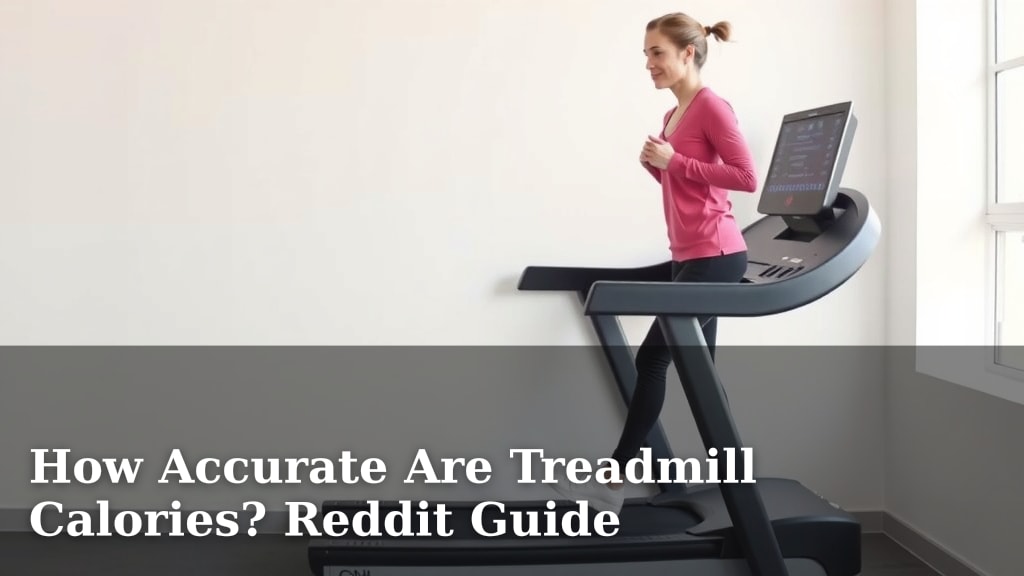
How Accurate Are Treadmill Calories? Reddit Guide
Treadmill calorie counters are often not very accurate, usually overestimating the calories you burn by about 10-20%. This is because they rely on basic formulas and user-input data, rather than your actual metabolic rate during the workout. So, while they offer a general idea, don’t treat those numbers as gospel for your fitness tracking.
The main reason for this inaccuracy is that treadmills can’t account for individual differences in metabolism, fitness levels, or even how you *actually* use the machine. Factors like your body weight and the incline you set play a role, but the machine’s calculation is still a bit of a best guess. We found many users reporting significant discrepancies compared to other tracking methods.
- Treadmill calorie counts are generally inaccurate.
- They often overestimate burned calories by 10-20%.
- Machines can’t track your unique metabolism or effort.
- User weight and incline affect the estimate, but it’s still rough.
- Think of it as a guideline, not a precise measurement.
Ready to get a clearer picture of your workout stats? Let’s dive into why treadmills miss the mark and what you can do to get a more realistic understanding of your calorie burn.
Understanding Your Treadmill’s Calorie Estimates
So, you’re hitting the treadmill, feeling the burn, and glancing at the screen. It tells you you’ve just torched 500 calories. Sounds great, right? But how much of that number is actually real? We’ve looked into it, and it turns out that most treadmills aren’t the most accurate calorie counters out there. They often give you a number that’s a bit higher than what you’ve truly burned.
Think of it like a guess. The treadmill takes some basic information you give it, like your weight, and applies a standard formula. It doesn’t know your unique body, your fitness level, or how hard you’re *really* pushing. This means the calorie count is more of an educated guess than a precise measurement. Many fitness enthusiasts on forums like Reddit have shared their experiences, often finding their treadmill’s numbers don’t match up with other tracking devices.
Why Treadmill Calorie Counts Miss the Mark
There are several key reasons why your treadmill’s calorie display isn’t always your best friend for tracking your workout. These machines use a simplified approach to a very complex process: burning calories.
The “One-Size-Fits-All” Formula Problem
Treadmills generally use a standard metabolic equation. This equation considers your weight and the intensity of your workout (speed and incline). It’s a good starting point, but it doesn’t account for individual variations in your body’s metabolism. Your body might be more or less efficient at burning calories than the average person the formula is based on.
Ignoring Your Personal Metabolism
Did you know that your resting metabolic rate is unique to you? It’s the number of calories your body burns just to stay alive. Treadmills can’t measure this. Your actual calorie burn during a workout is your resting rate plus the calories burned from the exercise. Since the treadmill doesn’t know your personal resting rate, its estimate will always be a bit off. This is a big reason why the numbers often seem inflated (NCBI).
The “Guestimate” on Effort Level
The treadmill sees your speed and incline. It assumes you’re working at a certain intensity based on those numbers. But how hard are you *actually* breathing? How much is your heart rate elevated? Are you gripping the handlebars or letting your arms swing freely? The machine doesn’t factor in your perceived exertion or your body’s real-time response to the workout. Some days you might be giving 110%, and the treadmill will show the same calorie burn as a day you felt a bit sluggish.
Body Composition Matters
The machine only knows your total weight. It doesn’t know the difference between muscle and fat. Muscle tissue burns more calories at rest and during exercise than fat tissue. So, if you have a higher muscle mass, you’ll burn more calories than someone of the same weight with a higher body fat percentage. Your treadmill can’t see this crucial detail.
Factors That Influence the Treadmill’s Estimate
While the treadmill’s calculation is a general estimate, certain inputs you provide do have an impact on the number it displays. Understanding these can help you interpret the data a little better.
Your Weight Input
This is the most critical piece of data you give the treadmill. If you input your correct weight, the calorie estimate will be more aligned with the formula than if you input an incorrect weight. Make sure you’re updating this if your weight changes. A heavier person will burn more calories than a lighter person at the same speed and incline, and the treadmill’s formula accounts for this difference.
The Speed and Incline Settings
These are the primary drivers of the “intensity” the treadmill measures. Running faster or increasing the incline will naturally increase the calorie count. This part of the calculation is generally more accurate because it directly relates to the work your body is doing against gravity and air resistance. However, it still doesn’t account for your personal efficiency.
Duration of Your Workout
The longer you’re on the treadmill, the more calories the machine will estimate you’ve burned. This is straightforward. It’s simply multiplying your perceived calorie burn rate by the total time spent exercising. This makes sense, as longer workouts generally lead to more calories expended.
Comparing Treadmill Data to Other Trackers
Many people use treadmills alongside other fitness trackers like smartwatches or heart rate monitors. This is a smart move to get a more well-rounded view of your workout metrics.
How Smartwatches and Heart Rate Monitors Differ
Devices like smartwatches and dedicated heart rate monitors often use more advanced sensors. They can track your heart rate throughout your workout. Many use this heart rate data, combined with your personal stats, to estimate calorie burn. Some also incorporate movement sensors and even GPS data (though GPS isn’t used on a treadmill). These devices can be more personalized because they track your *actual* physiological response to exercise. For example, if your heart rate is higher than average for a given pace, the device might estimate a higher calorie burn.
What the Reddit Community Says
We’ve seen countless discussions on Reddit where users compare their treadmill calorie counts to their smartwatches. The general consensus? Treadmills are consistently higher. Users report their treadmills showing 300-400 calories burned for a workout, while their smartwatch might show 250-300 calories for the same session. This difference highlights how treadmills tend to overestimate.
| Metric | Treadmill Estimate | Wrist-Based Tracker Estimate |
|---|---|---|
| Basis of Calculation | User weight, speed, incline, time | Heart rate, user weight, activity level, time, sometimes movement sensors |
| Personalization | Low (based on user input only) | Medium to High (adapts to heart rate and individual response) |
| Accuracy Tendency | Often overestimates (by 10-20% or more) | Generally more accurate, but can still vary |
| Factors Missed | Metabolism, body composition, actual effort | Can miss subtle effort changes, may overestimate if device fit is poor |
Getting the Most Realistic Calorie Picture
So, if the treadmill number isn’t perfect, what can you do? You can still use it, but with a healthy dose of skepticism. The goal is to get a better understanding of your effort and progress.
Use the Treadmill as a Guide, Not a Rulebook
Don’t let the exact number dictate your diet or your next workout. Think of the treadmill’s calorie count as a general indicator of how hard you worked. If the number is higher, it suggests you had a more demanding session. Use it for comparison between your own workouts. If you ran the same route at the same pace and the calorie count is higher today, you might have pushed a bit harder.
Focus on Heart Rate Zones
Instead of solely relying on calories, pay attention to your heart rate zones. Most treadmills display your current heart rate if you hold the sensors, and many wearables excel at this. Working out in specific heart rate zones is a more reliable way to train for different fitness goals, whether it’s fat burning or cardiovascular improvement (CDC). This number provides a better gauge of your physiological exertion.
Consistency is Key
The most important factor for tracking progress is consistency. If you always use the same treadmill and input the same information, your *relative* calorie burn numbers can still be useful. You’ll see if you’re burning more calories over time for the same workout duration and intensity as your fitness improves. This relative tracking is still a good measure of your progress.
Here’s a quick checklist to help you get a more realistic view:
- Always input your correct weight.
- Update your weight if it changes.
- Use a heart rate monitor for better effort tracking.
- Compare your treadmill data to other devices.
- Focus on trends rather than exact numbers.
- Listen to your body – how do you feel?
Conclusion
You’ve learned that treadmill calorie counts are a helpful starting point, but rarely the full story. They tend to overestimate your burn by 10-20% because they can’t measure your unique metabolism or true effort. While factors like weight, speed, and incline matter, they don’t capture your individual body’s efficiency. Instead of fixating on the treadmill’s number, use it as a general guide. Focus on your heart rate zones and tracking trends over time. This approach will give you a much more realistic and effective way to monitor your fitness progress.
Frequently Asked Questions
Will my treadmill’s calorie count ever be accurate?
Your treadmill’s calorie count will likely never be perfectly accurate. It uses general formulas that don’t account for your personal metabolism, fitness level, or body composition. Think of it as a rough estimate, not a precise measurement of your calorie expenditure.
What’s the biggest reason treadmills overestimate calories?
The biggest reason treadmills overestimate is their inability to measure your individual metabolic rate and true exertion. They rely on your weight and speed/incline settings, assuming a standard effort and efficiency that doesn’t match everyone’s body.
How can I get a more accurate calorie burn number?
To get a more accurate calorie burn number, use a heart rate monitor or a smartwatch. These devices often use your heart rate data, which is a better indicator of your body’s actual effort and calorie burn during exercise.
Should I trust my smartwatch over my treadmill for calories?
Generally, yes, you can trust your smartwatch or heart rate monitor more than your treadmill for calorie counts. These devices tend to be more personalized and responsive to your actual physiological state during a workout.
Can I still use the treadmill calorie number for tracking progress?
Yes, you can still use the treadmill’s calorie number for tracking progress, but focus on consistency. If you always use the same machine and input your details correctly, you can compare your numbers over time. An increase suggests you’re working harder or getting fitter for the same workout.