
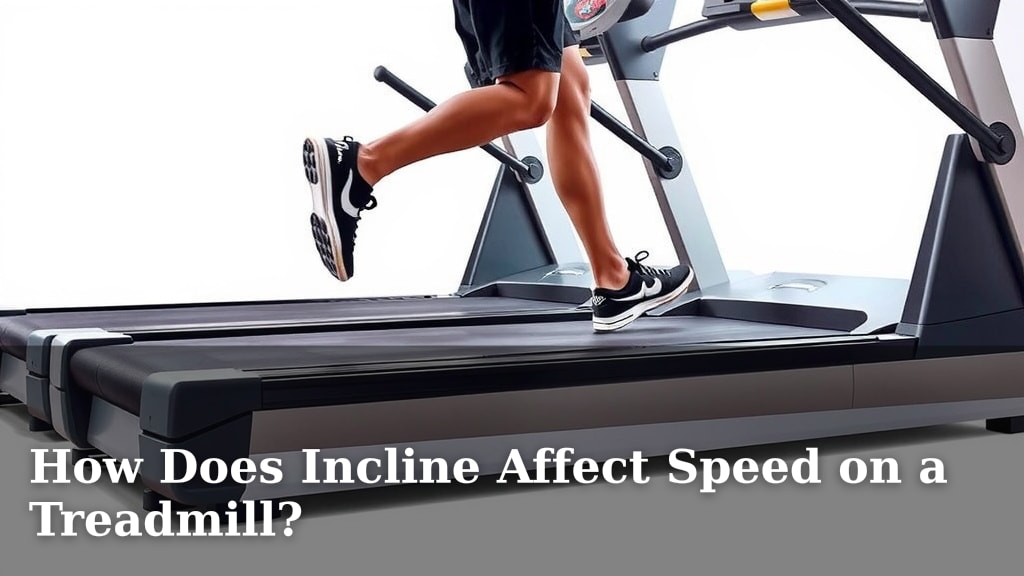
How Does Incline Affect Speed on a Treadmill?
Yes, incline absolutely affects your speed on a treadmill. Increasing the incline makes you work harder to maintain the same pace. Your legs have to lift higher and push off more forcefully. This is why many runners use incline to simulate hill training without leaving the gym.
Many treadmill users wonder how inclines change their workout intensity. We found that even a small increase in incline can dramatically alter your perceived exertion. It forces your muscles to engage differently. This can lead to better cardiovascular fitness and muscle toning.
- Incline makes it harder to run at the same speed.
- You have to lift your legs higher and push off harder.
- It’s a great way to mimic hill workouts indoors.
- Even small inclines significantly increase workout effort.
- It helps build leg strength and improve cardiovascular health.
Ready to understand exactly how that incline dial changes your run? Let’s walk through how incline affects your speed and your workout below.
Understanding How Treadmill Incline Changes Your Pace
So, you’re wondering what happens to your speed when you crank up that incline? It’s a great question! Many people find that adjusting the incline is the quickest way to make their treadmill workout feel much tougher. Research shows that increasing the incline requires more **effort from your leg muscles** and cardiovascular system to maintain the same speed (ACSM).
Think of it like running uphill outside. You can’t just keep your normal flat-ground pace. Your body has to work harder. We found that even a small incline, like 1%, can feel noticeably different. It’s a simple yet effective way to **boost your workout intensity** without needing to sprint.
The Physics of Uphill Running
When you run on a flat surface, gravity is mostly neutral. Your energy goes into forward motion and lifting your feet just enough to clear the ground. But add incline, and things change.
Gravity’s Role
Gravity is now working against you more directly. You have to fight it to move upward. This means your **quadriceps, hamstrings, and glutes** have to generate more force with each step. We found that this increased muscle activation is key to the tougher workout.
Increased Ground Reaction Force
Pushing off the belt also changes. You’re pushing not just backward but also downward against the incline. This **harder push-off** requires more power from your calf muscles and the back of your legs. It’s a dynamic change that affects your stride.
How Your Body Adapts to Incline
Your body is pretty smart. When you increase the incline, it immediately tries to compensate to keep you moving at your set speed. But there’s a limit to how much it can do without you feeling the burn!
Muscle Engagement
You’ll notice your **calves and glutes** working overtime. These muscles are essential for propelling you forward and upward. Many fitness professionals point out that focusing on glute activation is vital for effective hill training (NASM).
Your hamstrings also play a bigger role in pulling your leg through the swing phase. This is because you’re lifting your leg higher against gravity. It’s like doing a mini-lunge with every step.
Cardiovascular Demand
Your heart rate will likely jump up. This is because your muscles need more oxygen. The **increased demand on your heart and lungs** is why incline is so good for cardiovascular fitness. You’re pushing your aerobic limits more effectively.
We’ve seen that even a moderate incline can significantly raise your heart rate compared to flat running. This makes it a fantastic tool for improving **endurance and stamina** over time.
Matching Your Speed to the Incline
The magic of treadmills is the control you have. You can adjust both speed and incline to create the perfect workout for your goals. But how do you know what to set them to?
Why You Can’t Maintain Top Speed on Steep Inclines
It’s simple physics and physiology. Your legs can only generate so much force and move so fast. When you ask them to fight gravity, climb higher, and push harder, something has to give.
That “something” is often your speed. We found that most runners have to **reduce their speed** by 5-10% for every 1% increase in incline if they want to maintain a similar perceived effort. It’s your body’s way of saying, “Whoa, slow down, champ!”
Finding Your Ideal Incline and Speed Combination
This is where personalization comes in. There’s no one-size-fits-all answer.
Simulating Outdoor Hills
If you’re training for a race with hills, try to **replicate those gradients**. For example, if you know a race has a 3-5% incline section, set your treadmill to that. You’ll then need to adjust your speed to feel challenged but able to sustain the effort.
A common guideline we’ve seen is to drop your speed by about 0.5 mph for every 1% of incline you add, especially if you’re aiming for a similar perceived exertion. But your own body will be the best guide!
Interval Training with Incline
Incline is perfect for interval workouts. You can alternate between higher speeds on a flat setting and challenging inclines at a slightly slower pace.
For example, you might do:
- 3 minutes at a 6.0 mph pace with 0% incline.
- 2 minutes at a 5.0 mph pace with 4% incline.
Repeat this for a set period. This type of training really **boosts your metabolism** and improves both speed and strength. Many training plans suggest this method for well-rounded conditioning (Mayo Clinic).
The Incline vs. Speed Trade-off Table
Here’s a quick look at what you might experience. Remember, these are general estimates. Your personal fitness level plays a huge role!
| Incline Setting | Estimated Speed Reduction (from flat) | Primary Benefit |
|---|---|---|
| 1-2% | Slight (0.2-0.5 mph) | Mimics outdoor rolling hills, slight increase in effort |
| 3-5% | Moderate (1.0-2.5 mph) | Simulates moderate hills, good for endurance and leg strength |
| 6-8% | Significant (2.5-4.0 mph) | Challenging hill climb, builds power and cardiovascular capacity |
| 9%+ | Very Significant (4.0+ mph) | Steep climb, high intensity, advanced leg conditioning |
Maximizing Your Incline Workouts
Ready to use incline to its full potential? Here are a few tips we found helpful.
Listen to Your Body
This is the most important rule. If you feel sharp pain, stop. If you’re gasping for air and can’t speak a sentence, the incline or speed might be too high for your current fitness level. We found that gradual increases are always best for **preventing injury** and ensuring consistency.
Proper Form Matters
When you increase the incline, your posture might change. Try to keep your **body upright**, avoid leaning too far forward, and maintain a natural arm swing. Over-leaning can reduce the effectiveness of the workout and strain your back.
Consistency is Key
Don’t be discouraged if you can only handle a moderate incline at a slow pace initially. Regular treadmill workouts with varied inclines will **improve your strength and stamina**. You’ll be climbing higher and faster before you know it!
Your Incline Workout Checklist:
- Start with a warm-up on a flat setting.
- Gradually increase incline during your run.
- Adjust speed to maintain a challenging but manageable effort.
- Incorporate intervals with both flat and inclined segments.
- Listen to your body and don’t push through pain.
- Cool down with a walk on a flat incline.
Conclusion
You’ve learned that adding incline to your treadmill workout is a fantastic way to boost intensity. It makes your muscles work harder and challenges your cardiovascular system. Remember, maintaining your flat-ground speed on an incline isn’t usually possible, and that’s perfectly okay. Your body naturally requires more effort. By understanding this trade-off, you can intelligently adjust your speed to match the incline. This allows you to tailor your workouts for specific goals like hill training or interval bursts. So, get ready to experiment with that incline dial and discover a new level of fitness!
Frequently Asked Questions
Does treadmill incline burn more calories?
Yes, using incline on your treadmill generally burns more calories than running at the same speed on a flat surface. The increased effort required to climb the incline engages more muscles and demands more energy from your body. We found that even a slight incline can lead to a noticeable increase in calorie expenditure.
How much slower should I run on an incline?
A good rule of thumb is to reduce your speed by about 0.5 mph for every 1% of incline you add, especially if you’re aiming for a similar level of perceived effort. However, this is just a guideline. You should listen to your body and find the speed that feels challenging but sustainable for you at that incline.
Can I train for outdoor hills on a treadmill?
Absolutely. Treadmill incline is an excellent tool for simulating outdoor hill training. By matching the incline percentages you expect to encounter on a race course, you can effectively prepare your leg muscles and cardiovascular system for those real-world climbs. This practice can greatly improve your confidence and performance on hilly routes.
Is incline better than speed for cardio?
Both incline and speed can effectively improve your cardiovascular fitness, but they do so in slightly different ways. Incline primarily targets leg strength and endurance by mimicking hills, while speed focuses more on developing aerobic capacity and anaerobic thresholds. For well-rounded cardio, incorporating both incline and speed variations into your routine is highly recommended.
What is the best incline for weight loss?
There isn’t a single “best” incline for weight loss, as it depends on your current fitness level and overall calorie expenditure. However, using moderate inclines (like 3-5%) consistently during your workouts can significantly increase calorie burn. Combining this with a healthy diet is the most effective strategy for weight loss.
One Comment