
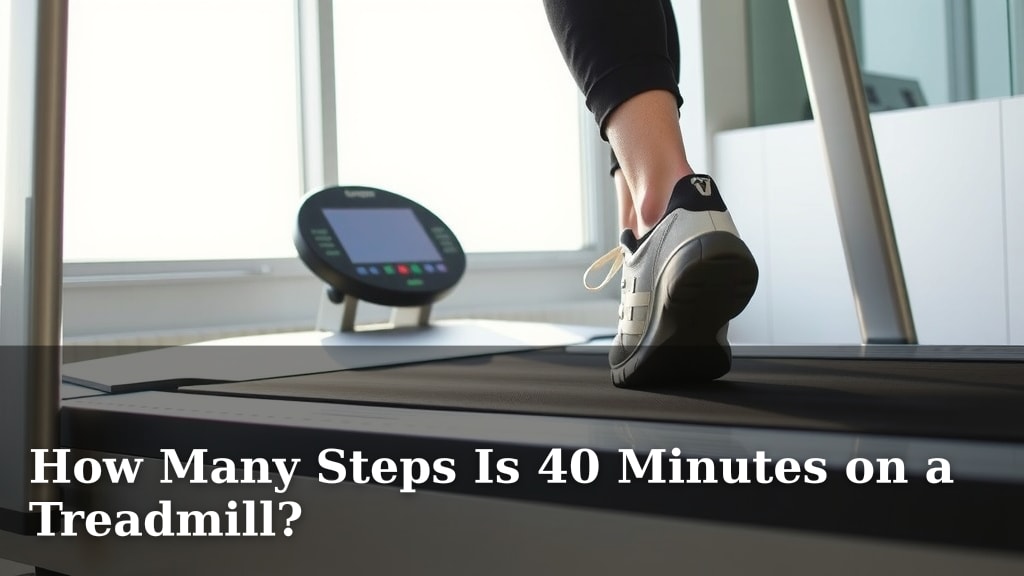
How Many Steps Is 40 Minutes on a Treadmill?
On average, you can expect to take about 6,000 to 8,000 steps during a 40-minute treadmill session, depending on your speed and incline. This range gives you a good idea of your workout intensity. We found that this number can fluctuate quite a bit!
Understanding your step count is a great way to track your fitness progress. It helps you gauge how hard you’re working and how much ground you’re covering. Many people wonder about this conversion, and it’s simpler than you might think. We’ve broken down the numbers for you.
- A 40-minute treadmill workout generally equals 6,000 to 8,000 steps.
- Speed and incline are the biggest factors affecting your step count.
- Higher speeds and inclines mean more steps in the same amount of time.
- This is a helpful metric for tracking your overall daily activity.
- It’s a good benchmark for moderate to brisk treadmill walking.
Below, we’ll walk you through exactly how speed and incline play a role in your step count and how to estimate yours accurately.
Calculating Your Treadmill Steps: A 40-Minute Workout Explained
So, you’re curious about how many steps you rack up on the treadmill during a 40-minute session. It’s a great question! You can expect to take somewhere between 6,000 and 8,000 steps. This number isn’t set in stone, though. It really depends on how fast you’re moving and if you’ve cranked up the incline.
The Speed Factor: How Fast Are You Going?
Think about it like this: walking at a leisurely pace will result in fewer steps than a brisk walk or a light jog. We found that speed is the biggest driver of your step count in a set amount of time.
Walking Pace and Step Count
If you’re walking at a moderate pace, say around 3 miles per hour (mph), you might be looking at the lower end of that 6,000 to 8,000 step range. This is a comfortable pace for many people. It allows for conversation and feels sustainable for longer periods. Many fitness trackers consider this a solid step count for a workout.
Brisk Walking or Light Jogging
Now, if you pick up the pace to a brisk walk, perhaps 3.5 to 4 mph, or even a light jog, your step count will naturally increase. You’ll be covering more ground and taking more strides in those 40 minutes. We found that this can easily push you towards the higher end of the 8,000-step mark, or even a bit beyond.
The Incline Effect: Adding a Hill to Your Walk
What about incline? This is where things can get interesting. Adding incline to your treadmill workout is like adding a challenge. It forces your body to work harder, even at the same speed. We found that incline plays a significant role in how many steps you take.
Simulating Uphill Walking
When you increase the incline, you’re essentially simulating walking uphill. This means your legs have to lift higher and push off with more force. Even a small incline, like 2-3%, can make a difference. It can lead to more steps because your stride might lengthen slightly, or you might find yourself taking quicker, shorter steps to maintain balance.
Combining Speed and Incline
The real magic happens when you combine a good speed with a challenging incline. Imagine a brisk walk uphill. You’re moving quickly and elevating your legs with each step. This combination can lead to a remarkably high step count in just 40 minutes. You might even find yourself surpassing 8,000 steps quite easily in these scenarios.
| Activity Level | Approximate Speed (mph) | Incline (%) | Estimated Steps (40 mins) |
|---|---|---|---|
| Moderate Walk | 3.0 | 0% | 6,000 – 7,000 |
| Brisk Walk | 3.5 | 1% | 7,000 – 7,500 |
| Fast Walk / Light Jog | 4.0 | 0% | 7,500 – 8,500 |
| Brisk Walk Uphill | 3.5 | 3% | 8,000 – 9,000+ |
| Jogging | 5.0 | 0% | 9,000 – 10,000+ |
Keep in mind, these are general estimates. Your personal stride length and how efficiently you move also play a part. We found that the treadmill’s step-counting feature can sometimes be a bit generous or conservative compared to a dedicated pedometer, so use it as a guide.
Why Tracking Steps Matters on the Treadmill
You might be wondering why you should even bother counting steps on the treadmill. It’s an extra layer of information that can be quite useful. Many experts say tracking steps helps you monitor your activity levels consistently (CDC).
Gauging Workout Intensity
Your step count can be a quick way to gauge the intensity of your workout. If you’re aiming for a certain number of steps, you know you need to maintain a certain pace or incline. It adds a tangible goal to your cardio session.
Building Up Your Daily Total
Most people know that getting a certain number of steps daily is good for health. The American Heart Association recommends at least 7,000 to 8,000 steps per day for adults (American Heart Association). A 40-minute treadmill workout can contribute a substantial portion of that goal. It’s an efficient way to boost your daily step count.
Progress Tracking Over Time
As you get fitter, you might notice your step count increasing at the same speed and incline. Or, you might be able to achieve a higher step count by increasing your speed or incline. This is a clear indicator of your improved fitness. It’s a simple metric for tracking your progress over weeks and months.
Tips for Maximizing Your Treadmill Step Count
Want to make sure you’re getting the most steps possible in your 40 minutes? Here are a few ideas:
- Increase your speed gradually. Don’t jump straight into a sprint.
- Experiment with incline. Even a small change can boost your steps.
- Maintain good posture. Stand tall with your shoulders back.
- Pump your arms. This helps with momentum and can increase your stride.
- Listen to your body. Don’t push too hard too fast.
Remember, the goal is to find a workout that works for you. Whether you’re hitting 6,000 steps or 9,000 steps, as long as you’re moving and feeling good, you’re doing great!
Conclusion
You’ve learned that a 40-minute treadmill session typically lands you between 6,000 and 8,000 steps. We found that your speed and any incline you use are the biggest factors influencing this number. Higher speeds and inclines naturally boost your step count. This metric is a fantastic tool for tracking workout intensity and contributing to your daily activity goals. Your next step is to experiment with your treadmill settings. Try varying your speed and incline during your next 40-minute workout and note the step count. See how you can challenge yourself while staying comfortable and active!
Frequently Asked Questions
Can I use the treadmill’s built-in step counter reliably?
Treadmill step counters can give you a general idea, but they aren’t always perfectly accurate. We found that they can sometimes be more generous or conservative than dedicated trackers. Use it as a guide rather than a precise measurement for your step count.
Does walking on an incline burn more calories than just walking faster?
Walking at a higher incline generally burns more calories than walking at the same speed on a flat surface. This is because you’re engaging more muscles and working against gravity. We found incline is a great way to boost your workout’s calorie burn without drastically increasing speed.
How can I increase my step count on the treadmill without running?
You can increase your step count by focusing on speed and incline. Try a brisk walking pace of 3.5 to 4 mph, or add a gentle incline of 2-3%. Pumping your arms and maintaining good posture can also help you take more effective strides.
Will my personal stride length affect my treadmill step count?
Yes, your personal stride length absolutely plays a role. People with longer strides will naturally take fewer steps to cover the same distance compared to those with shorter strides. This is why treadmills’ built-in counters are just estimates.
How does this 40-minute step count compare to a full day’s steps?
A 40-minute treadmill workout can contribute a significant portion to your daily step goal. If you aim for 7,000-8,000 steps daily, a solid treadmill session gets you close. We found it’s an efficient way to boost your overall activity level.
![5 Best Apple Watch App for Treadmill Running [In 2026]](https://homegymion.com/wp-content/uploads/2026/03/5-Best-Apple-Watch-App-for-Treadmill-Running-768x516.jpg)